Best Golf Hitting Mats (2026)
The best golf hitting mats for 2026: wrist-friendly, true-turf picks from SIGPRO, Country Club Elite, Fiberbuilt, GoSports, Rukket and CHAMPKEY, with thickness and tee guidance.
The best golf hitting mat for most home setups is the SIGPRO Softy, a thick foam pad with proprietary turf that feels close to a fairway and stays forgiving on fat shots. If wrist and elbow health is your top concern, the Country Club Elite and the fiber-bristle Fiberbuilt let the club pass through the shot instead of bouncing. On a budget, the GoSports Elite and CHAMPKEY mats cover the basics. Here are six real picks across price points, plus how to choose thickness, turf feel, and tee options.
Best Golf Hitting Mats for 2026

The Indoor Golf Shop SIGPRO Softy 4'x7' Golf Mat
Proprietary Teeline turf over a thick foam flex base for a realistic fairway feel that stays forgiving on fat shots; you can push a real wooden tee through it.

Real Feel Golf Mats Country Club Elite 4'x5' Golf Mat
Dense commercial nylon turf that lets the club slide through the shot instead of bouncing, and accepts a real tee anywhere on the surface for genuinely wrist-friendly practice.
Fiberbuilt Fiberbuilt Player Preferred Mat
Angled fiber-bristle hitting strip that absorbs impact and lets the club pass through cleanly, the long-running pick for golfers worried about joint strain on a hard mat.
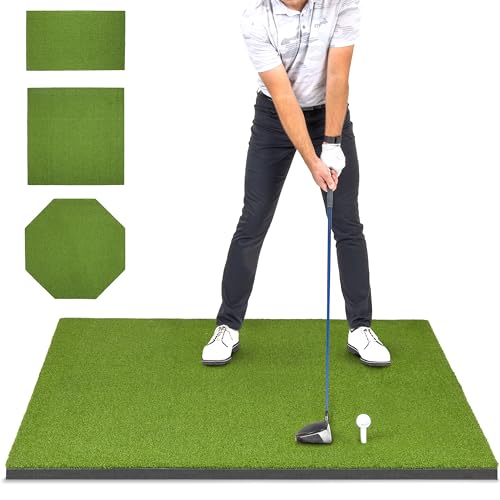
GoSports GoSports Elite 5'x4' Golf Hitting Mat
15 mm artificial turf on a firm rubber base sized for a full stance, with a foam underlay and rubber tees included for indoor or outdoor use.

Rukket Sports Rukket Tri-Turf Hitting Mat Attack
Compact three-surface mat with fairway, rough, and tee sections plus an adjustable rubber tee, ideal as a portable add-on or for chipping and wedge work.
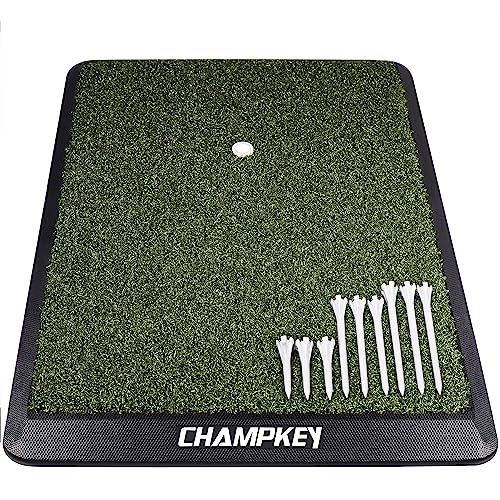
CHAMPKEY CHAMPKEY Premium Synthetic Turf Mat
Heavy-duty rubber-backed turf mat with swing-path feedback lines and a rubber tee included, the lowest-risk way to try mat practice before committing to a premium pad.
A hitting mat is the part of a golf simulator your body feels on every single swing, so it deserves as much thought as the launch monitor. The wrong mat, usually a thin pad on a hard floor, turns the club into a hammer that jars your joints and rewards skulled, thin contact because a steep divot-style strike bounces off. The right mat lets the club brush through the turf, gives honest feedback on a clean strike versus a fat one, and cushions the impact so you can hit balls for an hour without aching wrists.
Quick comparison
| Mat | Turf type | Real tee? | Best for | Price |
|---|---|---|---|---|
| SIGPRO Softy 4'x7' | Teeline over foam flex | Yes | Best overall, true feel | $999.99 |
| Country Club Elite 4'x5' | Dense commercial nylon | Yes | Wrist-friendly, slides through | $479.00 |
| Fiberbuilt Player Preferred | Angled fiber bristle | Yes | Premium, joint protection | Check price |
| GoSports Elite 5'x4' | 15 mm turf, rubber base | Rubber tee | Best value full-size pad | $149.99 |
| Rukket Tri-Turf Attack | Fairway / rough / tee | Adjustable rubber tee | Portable, chipping practice | $69.64 |
| CHAMPKEY Premium | Synthetic, rubber base | Rubber tee | Lowest price entry mat | $34.99 |
Amazon pricing moves around, so treat these as a snapshot. Before you buy, confirm the pad will fit your stance and your launch monitor's read zone with our golf sim room size calculator, and if you are still pricing the whole build, the golf sim cost calculator shows where the mat fits in the total.
SIGPRO Softy (Best Overall)
The SIGPRO Softy pairs a realistic Teeline turf surface with a thick foam flex base, and that combination is why it tops most home simulator lists. The turf gives the club a fairway-like slide and honest feedback, while the foam underneath absorbs impact so a slightly steep angle of attack does not jar your wrists. You can push a real tee straight through it for driver, and the 4x7 size gives you room to shift your stance and spread wear. It is an investment, but it is the mat owners rarely outgrow.
Country Club Elite (Best Wrist-Friendly)
The Country Club Elite, made by Real Feel Golf Mats, built its reputation on letting the club pass through the shot. Its dense commercial nylon turf is tight enough that a clean strike slides while a fat shot drags, exactly the feedback you want, and crucially it does not punish your joints the way a hard rubber-backed mat does. You can insert a real tee anywhere on the surface, and the commercial-grade construction holds up to heavy use. For golfers with elbow or wrist history, this is the safe pick at a sane price.
Fiberbuilt Player Preferred (Best Premium)
Fiberbuilt takes a different approach: instead of flat turf, the hitting zone is a strip of angled fiber bristles that compress and let the clubhead pass cleanly through impact. The result is one of the lowest-shock feels available, which is why it is a long-standing favorite among golfers nursing joint issues and among commercial ranges. It is usually a direct or specialty-retailer purchase rather than a standard Amazon stock item, so check current configuration and sizing on the listing before ordering.
GoSports Elite (Best Value)
The GoSports Elite is the sensible full-size pad for most first-time buyers. You get 15 mm of artificial turf on a firm rubber base, a foam underlay for some cushioning, and rubber tees in the box, all sized at roughly 5x4 feet so it covers a full stance. It is firmer than the premium mats, so a divot-digging swing will feel the floor more, but for sweeping iron contact and as a reliable simulator surface it punches well above its price. Pair it with a stance mat or a thicker base if you practice daily.
Rukket Tri-Turf Attack (Best Portable)
The Rukket Tri-Turf Attack is not a full bay mat, it is a compact three-surface pad with fairway, rough, and tee sections plus an adjustable rubber tee. That makes it a great portable companion for backyard or garage sessions, for working short game and wedge contact off different lies, or as an add-on stance and tee box next to a larger mat. It is inexpensive, packs away easily, and gives you varied lies that a single uniform surface cannot.
CHAMPKEY Premium (Best Budget)
The CHAMPKEY Premium is the lowest-risk way to try mat practice. It is a heavy-duty rubber-backed turf mat with swing-path feedback lines printed on the surface and a rubber tee included. It is firm, so it is best for occasional use or as a starter while you save for a cushioned pad, but the build quality is solid for the price and the feedback lines genuinely help with strike consistency. If you are not yet sure how often you will practice indoors, start here.
Fairway feel vs rough, and angle of attack
Most quality mats simulate a tight fairway lie, which is the lie you hit from most often. A few, like the Rukket Tri-Turf, add a separate rough section with longer fibers that grab the hosel and mute spin, useful for practicing recovery shots. What no mat can do is replicate the full divot of real grass, so a steep, dig-it-out swing that works on grass will feel different on a mat. The best premium mats narrow that gap by cushioning and releasing the club at impact rather than stopping it cold.
Thickness, shock absorption, and tee options
Two specs matter most for comfort: total thickness and what sits under the turf. Budget mats are typically 12 to 15 mm of turf on a thin rubber base, which transmits more shock, especially on a concrete garage floor. Premium mats add a deep foam or flex layer, so the club decelerates gradually. If you hit off concrete, either buy a thick mat or add a foam underlay. For tees, decide whether you need to hit driver: only mats that accept a real wooden tee, like the SIGPRO Softy and Country Club Elite, give a true driver setup, while firmer mats use a rubber tee seated in the base.
How we chose
We did not hit balls off these mats in a lab. Instead, we compared published manufacturer specifications, turf type and density, total thickness and base construction, whether the mat accepts a real tee, and listed dimensions, then weighed those against patterns in verified owner reviews on Amazon and at specialty golf retailers. We gave extra weight to two things owners consistently care about: how the mat treats your wrists and elbows over a long session, and whether the surface gives honest strike feedback rather than flattering every swing.
We deliberately mixed price tiers because the right mat depends on how often you practice and whether you swing down into the ball. Thickness, turf, and tee figures here come from manufacturer claims and listings, so treat them as estimates and confirm current specs on the product page. Pricing and exact configurations change, so the linked listings are the source of truth.
Buying tips
Start with your swing and your floor. If you have any wrist or elbow history, or you hit off concrete, prioritize a cushioned, pass-through mat like the SIGPRO Softy, Country Club Elite, or Fiberbuilt over a thin rubber-backed pad. Next, size it: the mat has to cover your full stance plus the clubhead's path, and it must coexist with your launch monitor's read zone, so check the layout with our room size calculator first. If you are still assembling the full bay, our guides to the best simulator projectors and best budget golf simulators round out the rest of the setup.
Finally, decide on tees and turf variety. If you want to hit driver indoors, buy a mat that takes a real tee. If you want to vary lies for short game, a tri-turf add-on alongside your main pad is cheap and useful. And remember the honest tradeoff: no mat fully replaces grass, but a good one protects your body and gives feedback you can trust, which is exactly what makes practice productive.
Golf Sim Build Planner
Room-fit worksheet, gear checklist, budget tracker, and wiring and lighting plan, in one printable planner that takes your build from idea to first swing.
Frequently Asked Questions
Are golf hitting mats bad for your wrists and elbows?
Cheap thin mats can be, because the club bounces off a hard base instead of digging in, and that jarring travels up to your wrists and elbows. The fix is a mat that lets the club pass through the shot. Mats like the Fiberbuilt fiber-bristle strip, the Country Club Elite, and the thick-foam SIGPRO Softy are designed to absorb impact and reward a slightly steeper angle of attack, which is far easier on your joints over a long session.
Which golf hitting mat feels most like real turf?
Dense commercial nylon mats give the closest fairway feel because the club slides through the surface rather than skidding across it. The Country Club Elite and SIGPRO Softy are the usual top picks for true-turf feel, and the Fiberbuilt bristle design mimics how a club passes through real grass. No mat replicates a fairway divot, but these come closest and give honest feedback on clean strikes versus fat shots.
Do hitting mats work with launch monitors and simulators?
Yes. Radar units like the Garmin R10 and FlightScope Mevo sit on the floor behind or beside the mat and read ball flight, so any mat works as long as the unit has a flat spot. Camera-based monitors that read the ground need a level, consistent surface, which larger mats like the GoSports Elite or a full SIGPRO pad provide. Check your monitor's placement guide, then size the mat so it covers both your stance and the device's read zone.
How thick should a golf hitting mat be?
Thickness drives shock absorption. Budget mats run around 12 to 15 mm of turf on a thin rubber base, which is fine for occasional use but firm under repeated full swings. Premium mats add a deep foam or flex layer underneath, sometimes an inch or more in total, so the club decelerates gradually instead of slamming into concrete. If you practice often or hit off a garage floor, prioritize a thicker cushioned base over raw turf height.
Can I use a real tee in a golf hitting mat?
Only on mats designed for it. The SIGPRO Softy and Country Club Elite let you push a real wooden or plastic tee straight through the turf, which is the most realistic way to hit driver. Firmer rubber-based mats like the GoSports Elite or CHAMPKEY include adjustable rubber tees that sit in a hole in the base instead. If hitting driver indoors matters to you, confirm the mat accepts a real tee before buying.
What size hitting mat do I need for a simulator?
For a full swing you want enough width to cover your stance plus room for the clubhead to travel, so a 4x5 or 5x4 foot pad is the practical minimum, and larger 4x7 or 4x10 mats let you move your stance around to spread wear. Confirm the mat fits your bay first with our golf sim room size calculator, then leave space for your launch monitor's read zone alongside the hitting area.
Building a golf sim?
Use our free calculators and guides to size the room, the gear, and the budget.
Build Planner: $39